







Program Overview
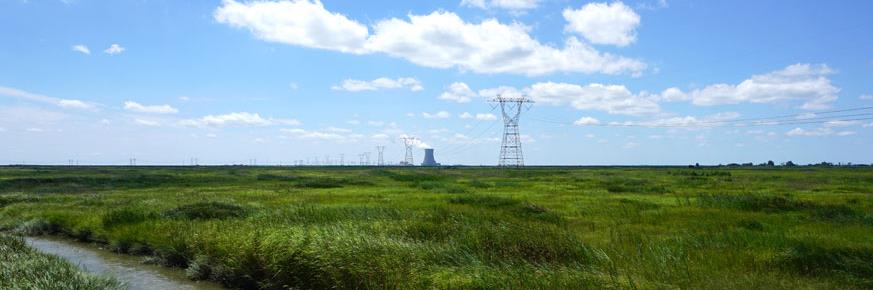
Restoring wetlands. Supporting wildlife. Strengthening our region.
The Estuary Enhancement Program (EEP) was established in 1994 by PSEG's Salem Generating Station in response to its New Jersey Pollutant Discharge Elimination System (NJPDES) permit. The program represents one of the most ambitious estuary restoration efforts of its kind.
Today, the EEP is recognized as one of the largest privately funded programs of its kind in the country – and possibly the world – with more than 20,000 acres of salt marsh and adjacent uplands restored, enhanced or preserved along the Delaware Estuary.
The program was developed and implemented in collaboration with experts in salt marsh restoration, ecology and aquatic biology, as well as independent scientists, environmental organizations, natural resource agencies, public officials and local communities.
Together, these partnerships support long-term restoration and stewardship of one of the region's most important ecosystems.
Program goals
The Estuary Enhancement Program focuses on delivering lasting environmental, ecological and community benefits across the Delaware Estuary by:
- Providing long-term benefits to the environment, natural resources, economy and communities of the Delaware Estuary.
- Promoting fisheries and aquatic resource productivity through innovative environmental improvement initiatives.
- Restoring, enhancing and preserving degraded salt marsh habitat and adjacent uplands in New Jersey and Delaware.
Restoring tidal marsh ecosystems
The Estuary Enhancement Program restores and enhances critical marsh habitat that supports fish, wildlife and coastal ecosystems throughout the Delaware Estuary.
Two primary restoration approaches are used across program sites.
Restoring diked salt hay farms
Historically, many marsh areas were diked and drained to support salt hay farming. These practices eliminated natural tidal inundation and reduced habitat for aquatic species.
EEP restoration projects reconnect these wetlands to the estuary by creating channels and breaching dikes to restore natural tidal flow. This allows fish access to marsh plains, promotes the re-establishment of Spartina alterniflora and other native marsh vegetation, and restores the natural exchange of organic material between marshes and the Delaware Estuary.
Restoring Phragmites-dominated marshes
Some marsh areas were heavily dominated by the invasive plant Phragmites australis, commonly known as Common Reed.
EEP restoration efforts control Phragmites and improve marsh drainage, allowing smaller tidal channels to form and creating conditions for native marsh vegetation such as Spartina alterniflora to return. These actions improve fish habitat, reduce the spread of invasive vegetation and support healthier marsh ecosystems.
Research, monitoring and innovation
In addition to habitat restoration, the Estuary Enhancement Program supports a range of scientific and environmental initiatives that help advance understanding of the Delaware Estuary ecosystem.
Program efforts include:
- Construction of 13 fish ladders to help river herring overcome barriers and reach historic freshwater spawning and nursery grounds.
- A bay-wide biological monitoring program, the most comprehensive ever conducted for the Delaware Estuary.
- Research on Phragmites control through a test area program evaluating methods such as mowing, seeding, micro-topographic modification, herbicide treatment and grazing.
- Development of public access facilities, educational signage and natural areas for recreation, research and environmental education.
Program impact
The Estuary Enhancement Program has produced long-lasting environmental and community benefits across the Delaware Estuary, including:
- Expanded habitat, nursery grounds and foraging areas for fish and aquatic species.
- Increased fisheries productivity and primary food sources.
- Improved habitat for endangered and threatened species, as well as resident and migratory birds.
- Increased biodiversity throughout restored marsh ecosystems.
- Expanded opportunities for recreation, environmental education and research.
A collaborative approach to restoration
The Estuary Enhancement Program demonstrates how science, collaboration and long-term commitment can address complex environmental challenges.
Through restoration, research and partnership, the program continues to strengthen the ecology, economy and communities of the Delaware Estuary region.
Frequently Asked Questions
-
The New Jersey restoration and preservation sites are located in Salem, Cumberland and Cape May counties. Click here for map of the sites with driving directions.
-
Click here for map of the sites with driving directions.
-
Yes, all sites are open to the public from 5AM to 9PM.
-
The sites feature amenities such as nature trails, interpretive signs, boardwalks, observation platforms and boat launches. Visitors can enjoy fishing, crabbing, trapping and hunting, as well as bird watching, hiking and wildlife observation. Click here (link to landing page for public use maps) for maps showing the public use amenities at each site.
-
Biodiversity faces a range of interconnected threats that affect ecosystems around the world. The primary drivers include habitat loss and fragmentation, invasive species, pollution, climate change and the overuse of natural resources. In coastal environments like the Delaware Estuary, degraded wetlands and invasive plants can reduce habitat quality for fish, birds and other wildlife.
The Estuary Enhancement Program helps address these challenges by restoring tidal wetlands, improving fish habitat, controlling invasive Phragmites and supporting long-term ecological monitoring to strengthen ecosystem health. -
Ecosystem restoration is the process of helping damaged or degraded ecosystems recover so they can function naturally again. Restoration may include re-establishing native vegetation, restoring natural water flow, improving wildlife habitat and controlling invasive species.
Healthy ecosystems support biodiversity, improve water quality, reduce flooding, store carbon and provide habitat for fish and wildlife. Through wetland restoration, fish passage improvements and ongoing scientific monitoring, the Estuary Enhancement Program helps restore important coastal ecosystems throughout the Delaware Estuary.
-
Biodiversity is important because healthy ecosystems depend on a variety of plants, animals and microorganisms working together. Greater biodiversity helps ecosystems better withstand environmental changes while supporting clean water, productive fisheries, pollination, nutrient cycling and wildlife habitat.
Restoring biodiversity also benefits local communities by improving recreational opportunities, supporting coastal resilience and maintaining ecosystems that contribute to regional economies.
-
Wetland restoration helps biodiversity by rebuilding healthy habitats where native plants, fish, birds and other wildlife can thrive. Restoring natural tidal flow, improving water quality and removing invasive species allows wetlands to support a greater variety of native species and strengthens the natural processes that keep ecosystems functioning.
Healthy wetlands also provide important ecosystem services, including nursery habitat for fish, nesting and feeding areas for migratory birds, flood mitigation, carbon storage and improved water filtration. As biodiversity increases, ecosystems become more resilient to environmental stressors such as climate change, invasive species and pollution.
Through the Estuary Enhancement Program, PSEG restores and enhances tidal salt marshes across the Delaware Estuary by reconnecting wetlands to natural tidal flows, improving fish passage through the construction of fish ladders, managing invasive Phragmites australis and supporting long-term scientific monitoring. These efforts have restored, enhanced or preserved more than 20,000 acres of marsh habitat, helping support healthier ecosystems and increased biodiversity throughout the region.